Lesson 13: MS in Determination of Isotopic Masses and Abundance

Lesson 152/153 | Study Time: 30 Min
Course: Chemistry XII
Lesson 13: MS in Determination of Isotopic Masses and Abundance

Learning Outcomes


By the end of this lesson, students should be able to:


i. Explain the concept of isotopes, including the variation in atomic mass due to the presence of different numbers of neutrons in atomic nuclei.


ii. Describe the use of mass spectrometry for determining the relative isotopic masses of elements and the abundance of different isotopes.


iii. Interpret mass spectra to identify the presence of different isotopes and calculate their relative abundances.


iv. Appreciate the importance of mass spectrometry in various applications, including isotopic dating, environmental monitoring, and pharmaceutical analysis.


Introduction


Isotopes, atoms of the same element with different numbers of neutrons, exhibit unique properties, including variations in atomic mass. Mass spectrometry, with its ability to separate and detect ions based on their mass-to-charge ratio (m/z), has become a powerful tool for determining isotopic masses and abundance. This lesson delves into the application of mass spectrometry in isotopic analysis, guiding students through the interpretation of mass spectra and the calculation of isotopic abundance.


i. The Isotopic Landscape: A Tale of Neutron Numbers


Isotopes of an element have the same number of protons but differ in the number of neutrons in their nuclei. This variation in neutron number leads to differences in atomic mass, as neutrons contribute to the overall mass of an atom.


ii. Mass Spectrometry: A Window into the Isotopic World


Mass spectrometry provides a precise and accurate method for determining isotopic masses and abundance. By measuring the m/z values of ions, mass spectrometers can distinguish between isotopes based on their mass differences.


Isotopic Patterns: A Fingerprint of Elements


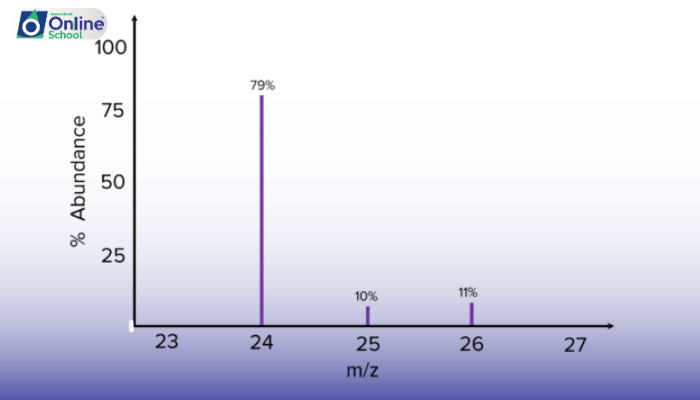
Mass spectra of elements exhibit characteristic isotopic patterns, with peaks corresponding to different isotopes and their relative abundances. The intensity of each peak represents the abundance of the corresponding isotope.


Relative Isotopic Abundance: Quantifying the Isotope Mix


Relative isotopic abundance is calculated by dividing the intensity of each isotope peak by the total intensity of all isotope peaks. This provides a percentage representation of the relative abundance of each isotope.


iii. Interpreting Mass Spectra: Unveiling Isotopic Composition


By analyzing mass spectra, scientists can infer the isotopic composition of a sample:


Identify Isotope Peaks: Recognize isotope peaks based on their m/z values and their spacing compared to the main ion peak.


Calculate Relative Abundance: Determine the relative abundance of each isotope using peak intensity ratios.


Characterize Isotopic Composition: Summarize the isotopic composition of the sample, including the presence of different isotopes and their relative abundances.


iv. Applications beyond the Ordinary: The Versatility of Mass Spectrometry


Mass spectrometry in isotopic analysis extends beyond basic research and finds applications in various fields:


Isotopic Dating: Determining the age of archaeological artifacts, geological formations, and meteorites.


Environmental Monitoring: Tracing the sources of pollutants and monitoring their distribution in the environment.


Pharmaceutical Analysis: Ensuring the purity and quality of pharmaceutical compounds, including the identification and quantification of isotopic variants.


Mass spectrometry, with its ability to distinguish isotopes based on their mass differences, has revolutionized the field of isotopic analysis. By interpreting mass spectra and calculating relative isotopic abundance, scientists can gain insights into the isotopic composition of various samples, with applications ranging from understanding planetary formation to ensuring drug safety. Mass spectrometry stands as a testament to the power of scientific instrumentation in unraveling the mysteries of the isotopic world.


Ahmed Hassan

Ahmed Hassan

Product Designer

Class Sessions

1- Lesson 01: Introduction to the Periodic Table 2- Lesson 02: Periodic Trends in Physical Properties 3- Lesson 03: Reactions of Period 3 Elements 4- Lesson 04: Properties and Behavior of Oxides, Chlorides, and Hydroxides 5- Lesson 05: Reactions of Oxides and Chlorides with Water 6- Lesson 06: Trends in Groups I, II, IV, and VII 7- Lesson 07: Reactions of Group I Elements 8- Lesson 08: Effect of Heat on Nitrates, Carbonates, and Hydrogen Carbonates 9- Lesson 09: Reactions of Group II Elements 10- Lesson 10: Solubility Trends in Hydroxides, Sulphates, and Carbonates 11- Lesson 11: Thermal Stability of Nitrates and Carbonates 12- Lesson 12: Differentiation of Beryllium 13- Lesson 13: Reactions of Group IV Elements with Water 14- Lesson 14: Chlorides and Oxides of Group IV Elements 15- Lesson 15: Halogens as Oxidizing and Reducing Agents 16- Lesson 16: Distinguishing Oxides and Peroxides 17- Lesson 17: Formation of Oxides and Sulphides 18- Lesson 18: Outermost s and p Orbital System 19- Lesson 01: Electronic Structures of d-Block Elements 20- Lesson 02: Anomalies in Chromium and Copper Electronic Configuration 21- Lesson 03: Reactions and Uses of Transition Metals 22- Lesson 04: Coordination Number and Crystal Structure 23- Lesson 05: Alloys and Their Properties 24- Lesson 06: Reactions of Potassium Dichromate 25- Lesson 07: Reactions of Potassium Manganate VII 26- Lesson 01: Introduction to Organic Chemistry 27- Lesson 02: Diversity and Magnitude of Organic Compounds 28- Lesson 03: Classification of Organic Compounds 29- Lesson 04: Use of Coal as a Source of Hydrocarbons 30- Lesson 05: Use of Plants as a Source of Organic Compounds 31- Lesson 06: Organic Compound Synthesis in the Lab 32- Lesson 07: Functional Groups and Homologous Series 33- Lesson 01: Classification of Hydrocarbons 34- Lesson 02: Nomenclature of Alkanes and Cycloalkanes 35- Lesson 03: Shapes of Alkanes and Cycloalkanes 36- Lesson 04: Unreactive Nature of Alkanes 37- Lesson 05: Fission and Free Radical Reactions 38- Lesson 06: Free Radical Substitution in Alkanes 39- Lesson 07: Organic Redox Reactions 40- Lesson 08: Chiral Centers and Optical Isomerism 41- Lesson 09: Identifying Chiral Centers 42- Lesson 10: Nomenclature of Alkenes 43- Lesson 11: Shape of Ethene Molecule 44- Lesson 12: Structure and Reactivity of Alkenes 45- Lesson 13: Isomerism: Structural, Stereoisomerism 46- Lesson 14: Dehydration and Dehydrohalogenation for Ethene Preparation 47- Lesson 15: Chemistry of Alkenes – Reactions of Ethene 48- Lesson 16: Conjugation in Alkenes 49- Lesson 17: IUPAC Naming System for Alkenes 50- Lesson 18: Shape of Benzene Molecule (Molecular Orbital Aspect) 51- Lesson 19: Resonance, Resonance Energy, and Relative Stability 52- Lesson 20: Reactivity Comparison of Benzene with Alkanes and Alkenes 53- Lesson 21: Delocalized Electrons in Benzene Ring 54- Lesson 22: Addition Reactions of Benzene and Methyl Benzene 55- Lesson 23: Mechanism of Electrophilic Substitution in Benzene 56- Lesson 24: Chemistry of Benzene and Methyl Benzene – Nitration, Sulphonation, Halogenation, Friedel-Crafts Alkylation, and Acylation 57- Lesson 25: Substituent Positions in Electrophilic Substitution of Benzene 58- Lesson 26: IUPAC Naming System for Alkynes 59- Lesson 27: Reactivity Comparison of Alkynes with Alkanes, Alkenes, and Arenes 60- Lesson 28: Shape of Alkynes 61- Lesson 29: Preparation of Alkynes Using Elimination Reactions 62- Lesson 30: Acidity of Alkynes 63- Lesson 31: Chemistry of Alkynes – Hydrogenation, Hydrohalogenation, Hydration, Bromination, Ozonolysis, and Reaction with Metals 64- Lesson 32: Substitution and Addition Reactions 65- Lesson 33: Isomerism in Alkanes, Alkenes, Alkynes, and Substituted Benzene 66- Lesson 01: Naming Alkyl Halides (IUPAC System) 67- Lesson 02: Structure and Reactivity of RX 68- Lesson 03: Preparation of RX 69- Lesson 04: Nucleophilic Substitution Reactions 70- Lesson 05: Elimination Reactions 71- Lesson 06: Preparation and Reactivity of Grignard’s Reagents 72- Lesson 07: Chemistry of Grignard’s Reagent 73- Lesson 08: Nomenclature, Structure, and Basicity of Amines 74- Lesson 09: Preparation of Amines 75- Lesson 10: Reactivity of Amines 76- Lesson 11: Chemistry of Amines 77- Lesson 12: Isomerism in Alkyl Halides and Amines 78- Lesson 01: Nomenclature, Structure, and Acidity of Alcohols 79- Lesson 02: Preparation of Alcohols 80- Lesson 03: Reactivity of Alcohols 81- Lesson 04: Chemistry of Alcohols – Preparation of Ethers and Esters, Oxidative Cleavage of 1, 2-Diols 82- Lesson 05: Thiols (RSH) 83- Lesson 06: Nomenclature, Structure, and Acidity of Phenols 84- Lesson 07: Preparation of Phenol 85- Lesson 08: Reactivity of Phenol 86- Lesson 09: Differentiation between Alcohol and Phenol 87- Lesson 10: Isomerism in Alcohols and Phenols 88- Lesson 01: Nomenclature and Structure of Aldehydes and Ketones 89- Lesson 02: Preparation of Aldehydes and Ketones 90- Lesson 03: Reactivity of Aldehydes and Ketones 91- Lesson 04: Acid and Base Catalyzed Nucleophilic Addition Reactions 92- Lesson 05: Chemistry of Aldehydes and Ketones – Reductions to Hydrocarbons, Alcohols, Using Carbon Nucleophiles, Nitrogen Nucleophiles, and Oxygen Nucleophiles 93- Lesson 06: Oxidation Reactions of Aldehydes and Ketones 94- Lesson 07: Isomerism in Aldehydes and Ketones 95- Lesson 01: Preparation of Carboxylic Acids 96- Lesson 02: Reactivity of Carboxylic Acids 97- Lesson 03: Chemistry of Carboxylic Acids – Conversion to Derivatives 98- Lesson 04: Reactions of Carboxylic Acid Derivatives 99- Lesson 05: Isomerism in Carboxylic Acids 100- Lesson 01: Carbohydrates - Basis of Classification and Structure-Function Relationship 101- Lesson 02: Carbohydrates - Role in Health and Diseases 102- Lesson 03: Carbohydrates - Nutritional Importance and Role as Energy Storage 103- Lesson 04: Proteins - Basis of Classification and Structure-Function Relationship 104- Lesson 05: Proteins - Role in Maintaining Body Functions and Nutritional Importance 105- Lesson 06: Enzymes - Role as Biocatalyst and in Food Digestion 106- Lesson 07: Factors Affecting Enzyme Activity - Temperature and pH 107- Lesson 08: Inhibitors of Enzyme-Catalyzed Reactions 108- Lesson 09: Lipids - Basis of Classification and Structure-Function Relationship 109- Lesson 10: Lipids - Nutritional and Biological Importance 110- Lesson 11: DNA and RNA - Structural Components 111- Lesson 12: DNA and RNA - Structural Differences 112- Lesson 13: DNA - Relating Sequences to Genetic Information Storage 113- Lesson 14: RNA - Relating Sequences to Protein Translation 114- Lesson 15: Minerals - Sources of Iron, Calcium, Phosphorous, and Zinc 115- Lesson 16: Minerals - Role in Nutrition 116- Lesson 01: Importance of Chemical Industries in the Economy 117- Lesson 02: Raw Materials for Chemical Industries in Pakistan 118- Lesson 03: Chemical Processes - Addition and Condensation Polymerization 119- Lesson 04: Petrochemicals vs. Derived Chemicals 120- Lesson 05: Fractional Distillation and Refining of Petroleum 121- Lesson 06: Raw Materials for Petrochemical Industry 122- Lesson 07: Identifying Important Fractions in Petrochemical Industry 123- Lesson 08: Basic Building Block Processes in Petrochemical Technology 124- Lesson 09: Petrochemical Process Technology and Major Petrochemicals 125- Lesson 10: Types and Applications of Hair Dyes 126- Lesson 11: Formation and Uses of PVC and Nylon 127- Lesson 12: Preparation and Applications of Cosmetics 128- Lesson 13: Types and Applications of Synthetic Adhesives 129- Lesson 01: Chemical Reactions in the Atmosphere 130- Lesson 02: Pollutants from Combustion of Hydrocarbon-Based Fuels 131- Lesson 03: Environmental Problems and Hazardous Compounds 132- Lesson 04: Causes and Impacts of Urban Smog 133- Lesson 05: Greenhouse Effect, Global Warming, and Climate Change 134- Lesson 06: Adverse Effects of Ozone in the Troposphere 135- Lesson 07: CFCs and Ozone Depletion in the Stratosphere 136- Lesson 08: Ozone's Role in Reducing UV Radiation 137- Lesson 09: Alternatives to CFCs 138- Lesson 10: Water Pollutants and Analysis Parameters 139- Lesson 11: Major Products of the Petrochemicals Industry and Their Uses 140- Lesson 01: Classical vs. Modern Analytical Methods 141- Lesson 02: Procedure of Combustion Analysis 142- Lesson 03: Spectroscopy and its Applications in Analytical Chemistry 143- Lesson 04: Regions of Electromagnetic Spectrum in IR and UV/Vis Spectroscopy 144- Lesson 05: Origin of IR Absorption of Simple Molecules 145- Lesson 06: Structure Determination from IR Spectrum 146- Lesson 07: UV/Visible Absorption Prediction 147- Lesson 08: Color Prediction of Transition Metal Complexes 148- Lesson 09: Principles of Proton NMR Spectroscopy 149- Lesson 10: Chemical Environment and Proton NMR 150- Lesson 11: Standard Scales in Proton NMR 151- Lesson 12: Mass Spectrometry (MS) Instrumentation and Working 152- Lesson 13: MS in Determination of Isotopic Masses and Abundance 153- Lesson 14: Atomic Emission and Atomic Absorption Spectrum